Procrastination is about emotion, not time
Dr. Fuschia Sirois at the University of Sheffield has produced some of the most rigorous research on procrastination in the past decade. Her consistent finding: procrastination is primarily a strategy for managing negative emotions, not a failure of time management or planning.
When a task triggers anxiety, self-doubt, boredom, or resentment, the brain's default response is to generate negative emotion and route attention away from the source. The avoidance provides short-term emotional relief — which is why it feels so compelling in the moment, even when the long-term consequences are obvious.
This is also why "just start" advice is useless. The person who can't start a task doesn't lack the information that starting would help. They lack the emotional regulation capacity to tolerate the negative feeling long enough to begin.
Why timers break the avoidance loop
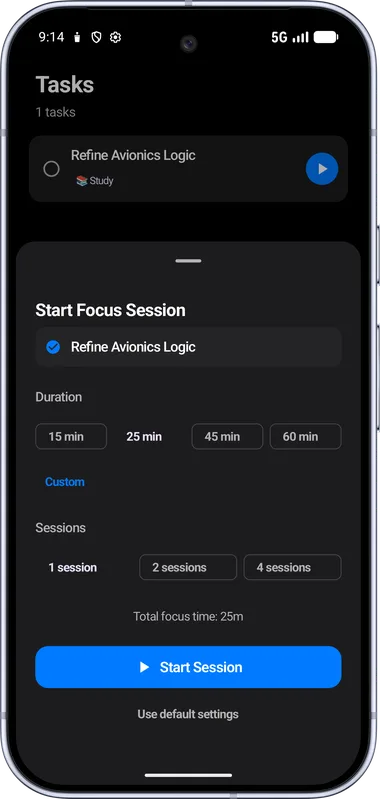
A focus timer works against procrastination through a mechanism called an implementation intention — a specific, concrete plan for when, where, and how to perform an action.
Research by Peter Gollwitzer at New York University shows that implementation intentions increase follow-through on intentions by 200–300% compared to goal intentions alone. "I want to finish my essay" is a goal intention. "I will work on this essay for 25 minutes starting now, at my desk, with the timer running" is an implementation intention. The specificity removes the decision-making load that procrastination exploits.
The timer also creates a psychological contract with a defined endpoint. "I only have to do this for 25 minutes" is emotionally negotiable in a way that "I have to finish this essay" is not.
Why most timers stop working after a week
The implementation intention effect of timers is real, but it depends on novelty and external accountability. After a week of using a basic timer app, the novelty fades. The timer becomes background noise — present but no longer compelling.
This is why most pomodoro apps have significant drop-off after the first week: they solve the initiation problem but not the retention problem. Willpower is finite and depletes over repeated use. A timer that relies purely on the user's discipline to keep working will lose that battle eventually.
Three things sustain timer use beyond novelty:
- Visual progress — the brain needs to see evidence that effort is producing something. A changing visual (not just a shrinking number) satisfies this need.
- External accountability — a leaderboard, a streak, a community. Something outside the self that cares whether you complete the session.
- Reduced friction for hard moments — an AI coach that handles the "I'm stuck" moment without requiring a browser tab to open.
The FocusFlow approach to each failure point
FocusFlow was built with each of these failure points explicitly in mind — not as a list of features, but as a design philosophy.
The Lantern Journey addresses visual progress: the lantern literally grows brighter as you work. The path ahead clears. This is not decorative — it makes the abstract (time passing) concrete and rewarding in real time.
The global leaderboard addresses external accountability: your completed sessions contribute to a weekly ranking against students in 50+ countries. The moment a session might feel pointless, there is a number that says otherwise.
The AI coach — Flow — addresses the stuck moment: instead of opening a browser to look something up and losing 40 minutes, you ask Flow without leaving the timer. The escape route closes.
None of these is magic. But together, they address the actual mechanisms of procrastination rather than assuming the user has unlimited willpower.
Try FocusFlow free on Android
Use the Lantern Journey timer, Flow AI Coach, and ad-free focus sounds in your next study session.

FAQ
Can a focus timer stop procrastination?
A focus timer can help by shrinking the start into a clear session with a defined endpoint. It works best when the timer also reduces friction and makes progress visible.
Why do I procrastinate even when I know what to do?
Often the task triggers anxiety, boredom, or uncertainty. A timer helps because it gives you a smaller emotional commitment: work for the next session, not solve the whole project right now.
How does Flow AI Coach help with procrastination?
Flow AI Coach can break a vague task into next steps without sending you into another app, which keeps the starting moment contained inside the focus session.