Why ADHD brains resist open-ended tasks
The prefrontal cortex governs task initiation, sustained attention, and inhibition — three functions that are measurably impaired in ADHD. When a task has no defined endpoint, the prefrontal cortex struggles to generate the activation energy needed to begin. This is why ADHD individuals often describe knowing exactly what they need to do, but being physically unable to start.
A 25-minute sprint changes the equation. The endpoint is defined, finite, and survivable. The brain can commit to 25 minutes in a way it cannot commit to "finish this assignment." Research by Russell Barkley — arguably the leading ADHD researcher — consistently shows that temporal task structures reduce initiation resistance in ADHD populations.
Time blindness: the most underdiagnosed ADHD symptom
Time blindness is the inability to sense the passage of time accurately. For most people, 20 minutes feels like roughly 20 minutes. For ADHD brains, 20 minutes can feel like 5 — or like 2 hours — depending entirely on how engaging the current moment is.
This is not a metaphor or an excuse. It is a neurological difference in how the basal ganglia processes temporal information. Barkley describes ADHD as fundamentally a disorder of self-regulation across time — not attention, not willpower, not laziness.
A digital countdown displaying "19:43" does not help time blindness. It presents the same abstract number as before, just smaller. A visual timer — one where you can literally see the passage of time as a changing image — is a fundamentally different intervention.
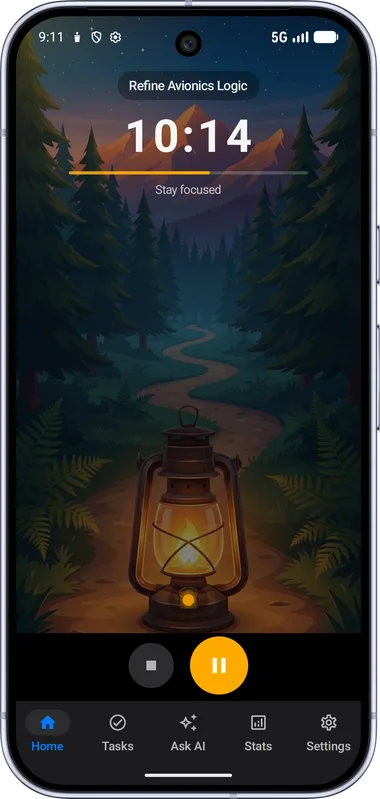
FocusFlow's Lantern Journey addresses this directly. The lantern grows brighter. The path ahead clears. These are not decorative — they are visual metaphors that make temporal progress legible to a brain that cannot otherwise perceive it.
The break is neurological maintenance, not laziness
The 5-minute break in the classic 25/5 pomodoro cycle is often misunderstood as a reward or as "permission to stop." It is neither. It is neurological maintenance.
During sustained cognitive effort, the prefrontal cortex depletes neurotransmitters — particularly dopamine and norepinephrine — at a faster rate than average in ADHD brains. The scheduled break allows partial restoration before the next sprint. Without it, performance degrades exponentially across sessions rather than linearly.
This is why the pomodoro technique produces better outcomes than equivalent time spent in continuous work — not because of the focus intervals themselves, but because of the enforced recovery between them.
Why most pomodoro apps still fail ADHD users
Most pomodoro apps solve the timing problem and nothing else. They give you a countdown, maybe a notification, and a session log. This is adequate for neurotypical users who are already disciplined and simply want structure.
ADHD users have two additional failure points that standard timers ignore:
- The stuck moment — when a hard topic triggers avoidance and the instinct is to open a browser. A built-in AI coach eliminates this exit without breaking focus.
- The motivation gap — when completing a session feels like it accomplished nothing visible. A leaderboard, a visual journey, a streak — external validation that ADHD brains need more than neurotypical brains do.
FocusFlow was built with both failure points in mind. The Lantern Journey handles the visual motivation. The AI coach — accessible without leaving the timer — handles the stuck moments. The global leaderboard makes each completed session matter beyond the individual user's internal discipline.
Try FocusFlow free on Android
Use the Lantern Journey timer, Flow AI Coach, and ad-free focus sounds in your next study session.

FAQ
Does the Pomodoro Technique help ADHD?
It can help because it gives the brain a short, visible commitment instead of an open-ended task. FocusFlow adds a visual Lantern Journey so progress is easier to feel while the session is running.
Why is a visual timer better than a countdown for ADHD?
A visual timer reduces time blindness by turning invisible time into a changing scene. That makes the session feel more concrete than a number slowly counting down.
Can I use FocusFlow without ads?
Yes. FocusFlow is built around ad-free focus sessions, including its timer and focus sounds.