What exactly is brown noise?
Brown noise (also called Brownian noise, named after physicist Robert Brown, not the colour) is a type of sound signal where the power spectral density decreases by 6dB per octave as frequency increases. In plain terms: it has much more energy at low frequencies than at high ones.
It sounds like a deep, steady waterfall, distant thunder, or a strong wind. It is deeper and less harsh than white noise, which distributes equal energy across all frequencies.
The colour naming convention for noise types — white, pink, brown, green — comes from the analogy with light: white light contains all frequencies equally, pink light emphasises lower frequencies, brown even more so.
Why ADHD brains seek stimulation — and why this matters
The ADHD nervous system is, in its baseline state, chronically understimulated in the reward and arousal pathways. This underlies many ADHD behaviours that look like poor impulse control from the outside: constant phone checking, fidgeting, background TV, loud music, seeking novelty.
These are not failures of self-discipline. They are the brain's attempt to reach adequate arousal levels for functioning. The challenge is that most stimulation sources — social media, music with lyrics, conversation — provide stimulation that is itself distracting. The input competes with the task.
The ideal sound for ADHD focus provides enough stimulation to satisfy the arousal-seeking nervous system without carrying informational content that hijacks attention. Brown noise fits this requirement better than white noise, silence, or music.
The research: what studies actually show
The specific research on brown noise and ADHD is still emerging, but the broader evidence base for auditory masking and ADHD is established. A 2020 study in the Journal of Attention Disorders found that moderate auditory stimulation improved cognitive performance and reduced mind-wandering in adults with ADHD more than silence did.
White noise specifically has been studied more extensively than brown. A landmark 2007 study by Söderlund et al. found that white noise improved cognitive performance in ADHD children while impairing it slightly in neurotypical children — the opposite effect. The theory (Stochastic Resonance) proposes that moderate background noise boosts weak neural signals in the dopaminergic system, helping ADHD brains reach optimal function.
Brown noise's lower frequency profile means it stimulates the auditory cortex without the slightly harsh high-frequency content of white noise — making it more sustainable for multi-hour focus sessions.
Brown vs white vs pink vs green noise for studying
Understanding which noise type to use for different tasks requires understanding what each prioritises:
- White noise — equal energy across all frequencies. Best for masking sudden environmental distractions like traffic, voices, or office sounds. Can feel slightly harsh over long periods.
- Pink noise — 3dB reduction per octave. The most "natural" sounding; found in rainfall, rivers, rustling leaves. Studies show it improves memory consolidation and sleep quality. Good for reading comprehension.
- Brown noise — 6dB reduction per octave. The deepest, most immersive. Best for tasks requiring sustained concentration and mental silence — writing, coding, deep problem-solving.
- Green noise — emphasises the 500Hz midrange, mimicking natural environments. Trending in 2025–2026 for its balance between stimulation and calm.
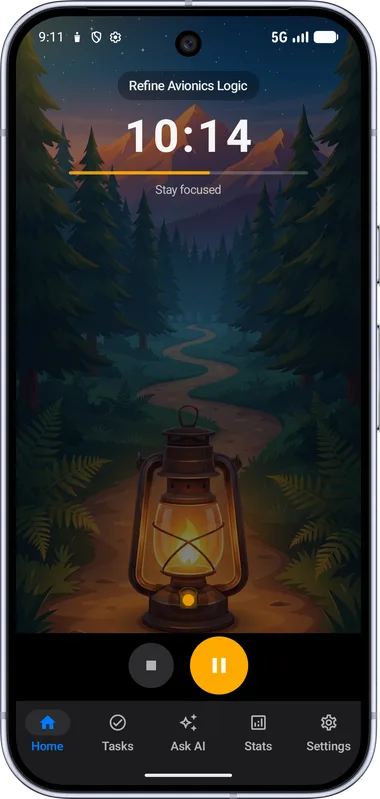
FocusFlow includes all four, plus rain sounds, ocean waves, and fireplace — categorised not just by type but by intended use case. "Brown Noise — Deep Work" is labelled differently from "Rain on Window — Deep Coding" because the right sound for essay writing differs from the right sound for debugging.
Try FocusFlow free on Android
Use the Lantern Journey timer, Flow AI Coach, and ad-free focus sounds in your next study session.

FAQ
Is brown noise good for ADHD focus?
Many people with ADHD find brown noise helpful because its deeper, steady sound can mask distracting background noise and create a predictable sensory environment.
Does FocusFlow include brown noise?
Yes. FocusFlow includes ad-free focus sounds such as brown noise, rain, and ocean so the audio does not interrupt the timer.
Should brown noise replace ADHD treatment?
No. Brown noise is a focus aid, not medical treatment. Use it as part of a broader routine and ask a clinician for medical advice.