What deep work actually means
Newport defines deep work as "professional activities performed in a state of distraction-free concentration that push your cognitive capabilities to their limit." The key word is limit — deep work is not just focused work, it is work at the edge of your current capacity.
The opposite — shallow work — is cognitive tasks performed while distracted, or tasks that don't require significant cognitive effort. Answering emails, re-reading notes, organising folders. These feel productive but don't produce the output that deep work does.
For students, the translation is direct: reading a textbook while checking your phone is shallow work. Working through problem sets with full concentration, building mental models from scratch, writing arguments under pressure — these are deep work. The difference in output quality and learning retention is not marginal. It is an order of magnitude.
The 90-minute deep work block and why it works
Newport recommends deep work blocks of 90 minutes to four hours for optimal output. The 90-minute figure has independent support from Peretz Lavie's research on ultradian rhythms — the natural oscillation of the brain between high-focus and low-focus states that occurs approximately every 90–120 minutes.
Trying to extend deep focus beyond 90 minutes without a break fights the ultradian rhythm rather than working with it. Trying to achieve deep work in blocks shorter than 45 minutes rarely reaches sufficient depth before the session ends.
For students using pomodoro timers, the bridge is: three consecutive 25-minute pomodoros with 5-minute breaks constitute an 85-minute deep work block — close enough to the 90-minute optimal, structured in a way that is psychologically manageable for ADHD brains and procrastination-prone students.
Building the pomodoro-to-deep-work bridge
The transition from single pomodoros to sustained deep work blocks requires two things: session chaining and task architecture.
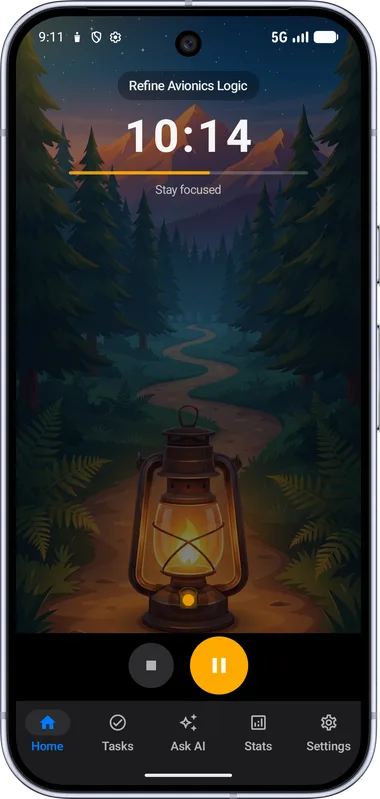
Session chaining means treating three consecutive pomodoros as a single unit, not three separate tasks. The 5-minute break is a physiological pause, not a decision point. You don't reassess whether to continue — you sit back down. FocusFlow's multi-session mode (1, 2, or 4 sessions chained) is designed exactly for this purpose.
Task architecture means preparing your task before starting the block so that the first 25 minutes are not spent orienting. Write down specifically what you will produce by the end of the 90-minute block — not "study chemistry" but "complete all problems in section 4.3 and identify the two concepts I don't understand yet." The specificity enables depth from minute one.
Deep work for students with limited schedule flexibility
Newport's framework assumes you can schedule 4-hour blocks. Most students cannot. The adapted version for constrained schedules:
- One 90-minute block per day is sufficient to produce meaningful deep work output and build the concentration muscle over time. More is better; one is the minimum viable dose.
- Identify your peak focus window using your timer's stats. FocusFlow's weekly overview shows which days and approximate times produce your longest uninterrupted sessions. Schedule your deep work block there.
- Prepare the night before — Newport calls this the "shutdown ritual." Before ending your study session, write the exact task for tomorrow's deep work block. This offloads the decision from the morning, when willpower is spent deciding whether to start at all.
- Protect the block like an appointment — the most common failure mode is treating deep work blocks as expandable when something else comes up. They are not. Shallow work fills every available slot if you let it.
Try FocusFlow free on Android
Use the Lantern Journey timer, Flow AI Coach, and ad-free focus sounds in your next study session.

FAQ
How long should a deep work timer be?
Many people build toward 60 to 90 minutes, but it is better to start with shorter sessions and increase only when the routine feels sustainable.
Can Pomodoro work for deep work?
Yes. Pomodoro can act as the entry ramp: several focused sprints can become a longer deep work block with breaks placed intentionally.
How does FocusFlow support deep work?
FocusFlow combines visual progress, focus sounds, AI help, and session stats so a longer block feels structured instead of vague.