
The psychology of tool aesthetics
Don Norman's foundational work in design psychology established what he called the visceral level of design — the immediate emotional response to the appearance of an object or interface. Norman argued that attractive tools are genuinely used more, maintained better, and produce more positive emotional states during use.
This is not superficial. Positive emotional states during task engagement are directly linked to sustained attention, creativity, and cognitive flexibility. A timer you find visually pleasing produces a measurably different internal state than a utilitarian countdown — and that internal state affects performance.
Study environment design and the ADHD brain
For ADHD users specifically, environmental aesthetics serve a functional purpose. The ADHD nervous system is activated by novelty and interest — two properties that a deliberately designed study environment can provide more reliably than a chaotic or generic one.
Research on "interest-based attention" in ADHD (a term coined by William Dodson) shows that ADHD individuals can achieve neurotypical-level sustained attention when engaged with material they find interesting or aesthetically stimulating. A study timer that is visually engaging reduces the effort required to initiate and maintain focus sessions.
This is why the most-downloaded productivity apps for ADHD users — Forest, Finch, FocusFlow — all prioritise visual design over functional minimalism. The aesthetic is not decoration. It is the mechanism.
What makes a pomodoro timer aesthetically effective
Not all aesthetic choices are equal for focus tools. Three principles distinguish effective visual design from decoration:
- Progress visibility — the visual must change in a meaningful way as time passes. A static background with a number overlay is not progress visibility. A lantern that brightens, a tree that grows, a path that clears — these are.
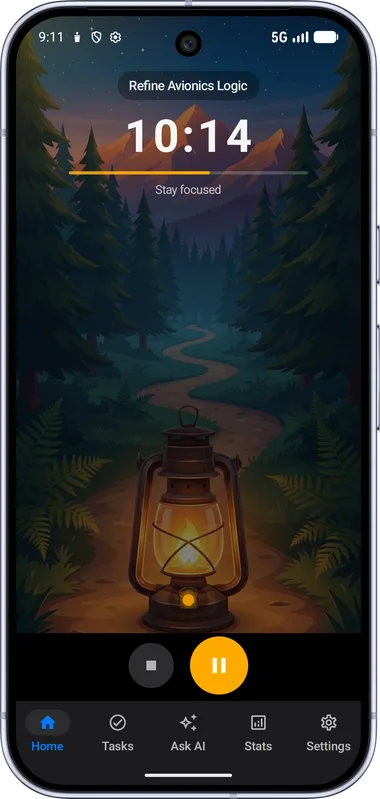
- Emotional congruence — the aesthetic should match the desired emotional state. Forest's nature aesthetic induces calm. FocusFlow's lantern journey induces quiet determination. A timer with aggressive colour gradients induces stimulation that may not serve all task types.
- Low cognitive overhead — aesthetic complexity that requires interpretation or tracking draws cognitive resources away from the actual task. The best designs are immediately readable and emotionally resonant without demanding attention.
Aesthetic pomodoro timers across different study cultures
The aesthetic pomodoro trend has different flavours across study cultures, which is reflected in how different markets search for focus tools.
In France and Spain, "aesthetic pomodoro timer" is consistently one of the top search queries — users are explicitly looking for visual beauty as a feature, not a side effect. In Japan and Korea, "study with me" videos — which often feature aesthetic timers as focal props — drive a significant share of productivity app discovery.
FocusFlow's Lantern Journey was designed with this cross-cultural aesthetic appetite in mind. The warm amber lantern against a dark forest background works as a visual anchor across cultural contexts — warm, focused, atmospheric, and emotionally coherent with sustained effort.
Try FocusFlow free on Android
Use the Lantern Journey timer, Flow AI Coach, and ad-free focus sounds in your next study session.

FAQ
Why do aesthetic Pomodoro timers help focus?
Beautiful tools can make starting feel less abrasive and give the brain a more rewarding signal while effort is happening.
Is the Lantern Journey just decoration?
No. The Lantern Journey is meant to make progress visible, which can reduce time anxiety during the focus block.
Can an aesthetic timer still be productive?
Yes. The goal is not decoration for its own sake; it is a calmer focus environment that you want to return to.